Raw Water Marine Cooling – The Difference Between Warm Vs Cold Manifolds
Thermostat Housings
Warm versus cold marine exhaust manifolds refers to the temperature of the cooling water that is introduced into the exhaust manifolds on a marine cooling system. This specific system feature can apply to raw water (also known as open cooling) systems as well as Fresh Water (also known as closed cooling) systems. For the purpose of this article we will be primarily detailing the raw water cooling systems. To read more about 1/2 versus full closed cooling systems, select this link.
The standard raw water cooling system operates via a pressure balance. The easiest way to think about these systems is that you have a circuit of coolant being circulated through the engine via the engine circulating pump. There is also a supply pump that introduces cooling water into this circulation loop, depending on the position of the thermostat and amount of coolant being allowed to exit the system. For example the circulating pump on a standard small V8 GM based engine will flow approximately 50 gpm through the engine. The typical raw water supply pump inside the Alpha sterndrive is capable of flowing about 18 – 20 gpm depending on the gear ratio and restriction the system experiences. A standard 300 Hp small V8 engine dissipates approximately 300,000 Btu/Hr of heat into the coolant. To maintain a thermostat temperature of 160 degree F at wide open throttle this engine would need a pump to flow about 8 gallons per minute (GPM) of 70 degree F water into the system to maintain this engine temperature. Since the Alpha raw water pump can flow 18-20 GPM there is significant bypass (excess) water supplied, which therefore has to be dis-charged somewhere.
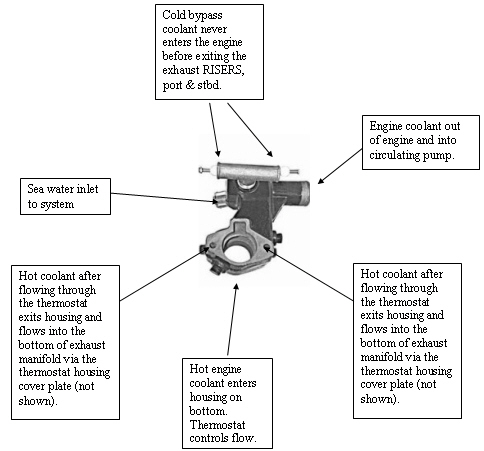
In a cold manifold system the warm water that flows through the thermostat, as well as this excess bypass water are joined together in the thermostat before exiting and being introduced into the bottom of the exhaust manifold. The fact that your are mixing together a lesser amount of 160 degree F engine water (8 GPM) with 10+ GPM of cold lake water allows the aggregate coolant temperature in the manifold to fall below the 110 degree F threshold needed to prevent the accumulation of condensation in the exhaust system. Notice in the picture below that there are only (4) hose bibs as these systems are typically identified by this fact.
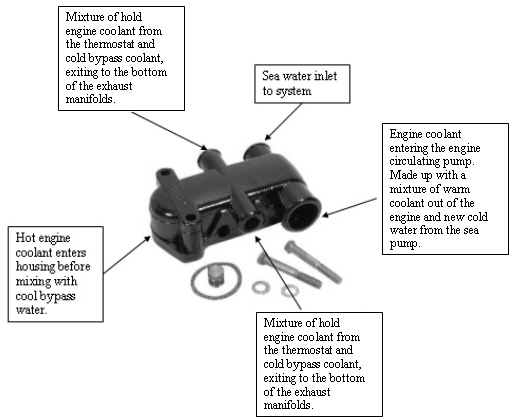
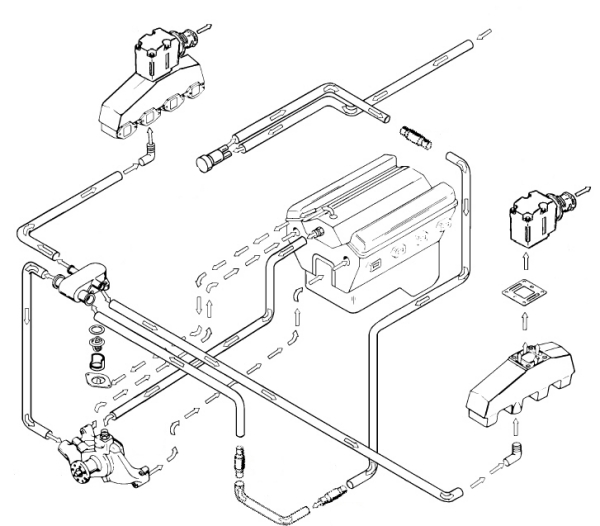
In a warm manifold system the warm water coming out of the engine and through the thermostat is the only coolant that actually passes through the exhaust manifolds before passing through the manifold riser gasket joint and mixing with the cold bypass water that is being introduced into the riser. The fact that your mixing point for the coolant is above the manifolds allows the temperature to be maintained above 110 degrees F and therefore prevents the accumulation of condensation in the exhaust system. Notice in the picture below that there are (6) hose bibs as these systems are typically identified by this fact. NOTE: The thermostat cover is not shown but actually contains the additional (2) hose bibs.
WARM MANIFOLD SYSTEM