


Marine Corrosion Resistance, Prevention and Control
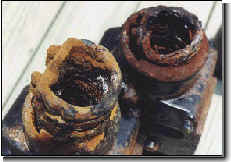
MARINE CORROSION – WHAT IS IT?
No Marine Engine can escape the damage from Marine Corrosion. Marine Corrosion happens to Mercruiser Parts & Mercury Outboard Parts alike. In it’s simplest form is really a pretty basic phenomenon; Simply put, marine corrosion is an electrochemical reaction that happens when electrons flow between metals that are connected or grounded through water. What does this matter to you? Marine corrosion is the defining factor with regards to the longevity of your boat engine, boat exhaust system and sterndrive. As it happens, this electrical action causes one of the two metals to literally be eaten away – marine corrosion. The process is greatly accelerated in salt, brackish waters, or in waters with a high mineral content. That’s marine corrosion in a nutshell.
MARINE CORROSION ELEMENTS
There are four essential elements necessary to accommodate marine corrosion. The first of which is the ANODE. The anode is the material that actually gives itself up as marine corrosion takes place. You may have noticed people with zinc anodes mounted on the stainless steel trim tabs on their boats. In many cases, people think Zinc is always the best material to use for an anode. This is not necessarily true. The materials must be matched with regards to the potential between the anode AND the cathode. Zinc makes a very good anode when coupled with aluminum, however in the case of stainless steel a piece of standard angle iron is a much better option. The reason for this is that the potential between stainless steel and zinc is so great that the zinc actually sacrifices itself too fast and will actually create a problem.
The second element of marine corrosion is the CATHODE. The cathode is generally the factor that controls the rate of corrosion within the cell.
The third element of marine corrosion is the ELECTROLYTE or fluid within the cell and is generally what dictates the speed of corrosion, depending upon the conductivity of the fluid. Seawater readily supports corrosion cells as seawater is nearly 100% ionized as well as being considered very conductive.
The fourth element of marine corrosion is the external circuit. If the cell is made up of two metals, these two metals must be in contact in order for marine corrosion to take place. Hence the idea behind devices that emit a positive charge from the system they are connected with. In generality one might assume they reduce the amount of marine corrosion to their own system by introducing voltage to the systems in the surrounding area. While sharing a common ground, once the two dissimilar metals (anode & cathode) are submerged in water (electrolyte), a chemical reaction takes place (current flow) which literally causes the anode metal to be eroded (corrosion) away.
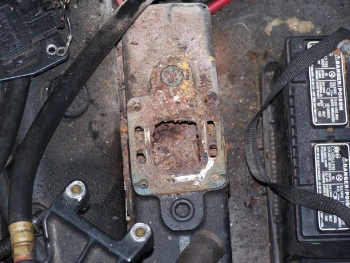
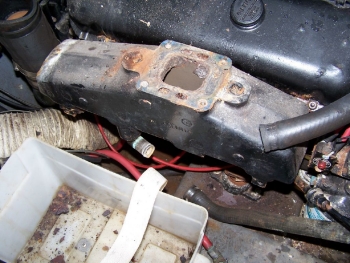
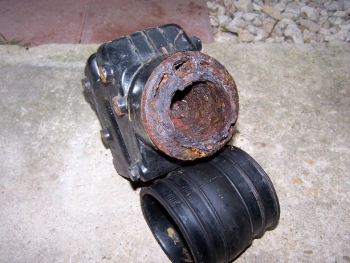
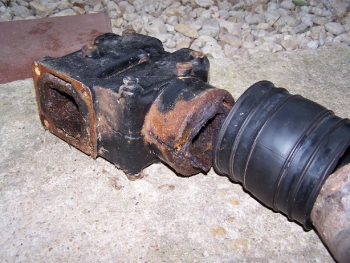
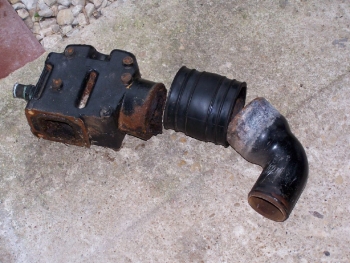
This is a very generalized explanation of how marine corrosion takes place. This is in no way intended to be a synopsis surrounding every detail involved with marine corrosion. In reality the details of marine corrosion probably don’t matter much to most people, however there are some people who want to understand just the basics. For many people, marine corrosion is probably the one single largest factor in determining longevity to your boat engine, boat exhaust system, or sterndrive. It doesn’t take a metallurgist to apply the many beneficial techniques one can use to protect their boat engine from marine corrosion, etc. With all of this in mind, the main thing to keep in mind is that you can beat the marine corrosion issue. How? Preventive maintenance! There are three basic things that will significantly increase the longevity of your boat engine, boat exhaust system, or sterndrive.
1. Fresh Water Cooling
2. Engine Fogging
3. Engine Protection Products
Feel free to research our other links to gather information regarding these above items. The time invested on the front end to understand these items will be of immeasurable value in regards to the longevity of your boat engine, boat exhaust system, or sterndrive.